F-35 training center begins formal training

While celebrating each F-35 Lightning II arrival, the integrated joint strike fighter training team also recently opened the doors for the first Air Force certification courses on the logistical support behind the nation's newest weapons platform.
The 33rd Fighter Wing has eight basic familiarization courses now in session at the academic training center with courses currently scheduled through early next year. Approximately 100 maintenance students from three branches of service began the inaugural classes March 19.
"This is hugely significant for all services because we are getting our maintainers prepped for when we are fully stood-up for F-35 training in the near future," said Col. Andrew Toth, the 33rd FW commander. "The classes are another exciting step forward in the 2012 execution year for F-35 training."
Every step has an effect on the future of these new programs.
"What we do now hinges on the progress of joint technical data verification for the F-35's maintenance procedures, virtual-reality trainer software validations and upgrades, as well as course delivery methods coming online," said Senior Master Sgt. Richard Brown, the F-35 ATC superintendent. "Up until this point, we've been conducting small group try outs with the integrated maintenance team here to verify the system is meeting the requirements needed."
After the team's try-out process was completed, ATC personnel were able to offer Air Force students their first certificate of completion in F-35 courses for structures, avionics, weapons and crew chief career fields. Crew chiefs assigned to the wing already gained familiarization of flight line tasks and performed duties on the flight line associated with generating sorties.
Seasoned maintainers crossing over to the new aircraft platform were selected to attend the first classes. Marine Corps students hail from careers in ordnance, avionics, power line and airframes. To share the resources of instructors and trainers, the ATC runs two class shifts with schedules occasionally ending as late as 1 a.m.
"The pipleline students, those learning to be maintainers, are anticipated to train at the ATC early 2014," Brown said. "Most of the students going through will be instructors when they stand up field training detachments."
At the ATC, students have access to computer simulators touting near-realistic interaction with the jet aided by a digital "avatar." Additionally, virtual training is provided on life-size mock-ups of F-35 components.
Lockheed Martin's F-35 platform includes the aircraft itself as well as the logistics and sustainment support systems, designed to keep each plane in the air and fully operational. Courseware is built using a flexible modular design, making it possible to train war fighters from three different services and eight international partners on three F-35 variants without creating multiple training suites of variant-specific hardware and software, according to Lockheed Martin's website. This total training solution lets trainees get immersed in the virtual experience before moving to the real thing.
Students currently enrolled are going through the phases of training designed by ATC personnel.
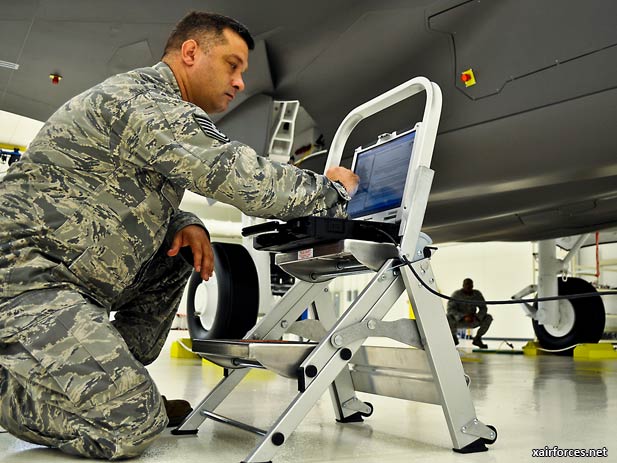
"The first week of training for all specialties is basically the same," said Brian Vohl, a Lockheed Martin weapons instructor. "The desktop trainers, such as the Aircraft Systems Maintenance Trainer, require each student to follow the procedures of checking out virtual tools, reading the maintenance checklists and individually performing each task."
After ASMT training, the students break off into their specific disciplines to train virtually at the ATC before heading out to the operational side of the wing where the fifth-generation fighter is housed with each service's flying squadron.
"You can read about it all day, but you actually need a feel for the aircraft, work environment and know how the parts of the jet move," said Staff Sgt. Frantavious Dooley, a weapons crew chief assigned to the 57th Aircraft Maintenance Squadron at Nellis AFB, Nev.
The classroom experience combined with flight line operations are beneficial for learning about aircraft safety, in particular the warnings and precautions outlined in the joint technical, he said.
Classmates from Air Force flight test units will take lessons learned here home to implement F-35 sustainment at their units. Hill AFB, Utah, is slated to be a depot maintenance site and Nellis AFB and Edwards AFB are operational test sites.
"I like the process; the new approach is 100-percent compliant with learning tasks," said Tech. Sgt. Johnathan Meyer, an F-35 weapons instructor assigned to the 359th Training Squadron here. "Finishing off the comprehensive approach to training, the student gets aircraft hands-on training at an active flight line."
Meyer said he attended the ATC weapons class to evaluate and lend feedback of the overall training program based on his five-year expertise as an instructor for Air Force maintenance technical training.
"When training is in full swing, approximately 2,100 maintainers and 100 pilot students can be processed through the ATC annually, with 900 people at any given time on campus," Toth said. "Classes last from one to three months depending upon the course."
Source: EGLIN AIR FORCE BASE, Fla. (AFNS) | by Maj. Karen Roganov - 96th Air Base Wing Public Affairs - Friday Apr 16, 2012 (AF.mil)
Photo: Tech. Sgt. Brandon Sullivan uses a portable maintenance device loaded with joint technical data that's plugged into an F-35 Lightning II trainer April 3, 2012, during a weapons familiarization course at Eglin Air Force Base, Fla. The 17-day course was the first weapons course completed since Eglin AFB’s F-35 Academic Training Center began formal training Mar 19. Sullivan is an aircraft armament systems technician assigned to the 33rd Aircraft Maintenance Squadron at Eglin AFB. (Photo by U.S. Air Force photo/Maj. Karen Roganov)
(16.04.2012)
|



 4/5 Generation Fighters