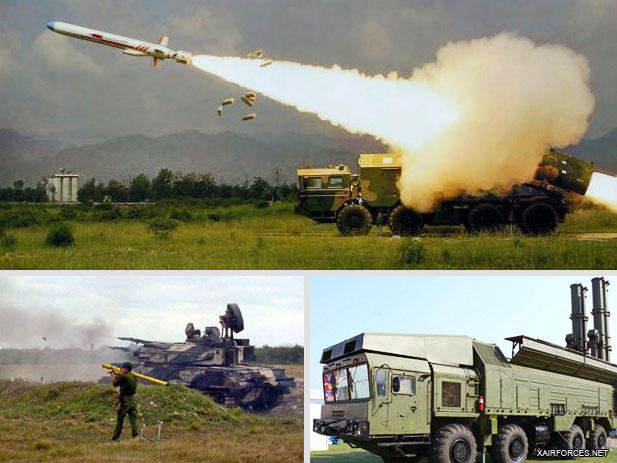
Syria deploys L-300P “Bastion” missile system along coastline

Syria is deploying the “Bastion” advanced missile system along its coast. There had been uncertainty over the contract to supply Syria with Russia’s advanced mobile coastal defence system L-300P “Bastion” carrying “Yakhont” missiles.
Few people believed in the possibility of supplying Damascus with these weapons after the launch of the “reset” between Russia and the U.S. in 2009 because the move could really upset the balance of power in the Eastern Mediterranean.
The U.S. and Israel have always been the main opponents of weapon deals between Russia and Syria, but their respective reactions to the supply of the “Bastion” system to Syria were different. When the U.S. traditionally expressed its indignation over the deal, Israel’s reaction was almost unnoticeable except some general statements made by the Israeli foreign ministry, even though Israel should be the first to worry about upgrades in Syria’s defence capability.
But, there was a reason for Israel’s sluggish response to the supply of the “Bastion” system to Syria. It’s related to the balance of power between Tel Aviv and Damascus, as well as the current situation in the region.
The outcome of a possible conflict between Israel and Syria would be mainly decided in the air and on the land. In this scenario, naval supremacy would be of secondary importance because regardless of Syria’s hypothetical successes in attacks on the Israeli navy, they would do nothing to influence the out come. .
For Israel, the threat posed by Syria’s Air Force, Ground Forces and air defence systems is seen as more significant. Consequently, the supply to Syria of air defence systems, fighter jets, advance armoured vehicles and weaponry for the ground forces is a cause for a greater worry for Israel. Particularly as there is a considerable chance that military equipment and the weaponry intended for the ground forces might fall into the hands of terrorists. This particularly applies to such weapons as shoulder fired anti-aircraft and antitank missiles, light armoured vehicles and firearms.
Theoretically, under the guise of terrorists Syrians themselves could launch attacks on Israel from the regions controlled by Syria. But one should note that in the current situation, Syria does not need any conflicts with Israel.
Why has Syria bought the “Bastion” system? Whose ships will be targeted by the “Yakhont” missiles? There is a clear answer to these questions: it’s the Turkish navy. The relations between Syria and Turkey have worsened especially after Turkey joined the countries that imposed sanctions on Syria and put its troops stationed along the Syrian border on high alert. The probability of a conflict between the two countries has recently risen. Such a conflict would benefit the U.S. because it would pave the way for once again undermining the position of Iran, which is a partner of Syria. Thus, one cannot exclude the possibility of an attempt by the U.S. to further its interests in the region by using Turkey “cleanse” Syria.
Provided that Syria approaches the process of formation and training its personnel, the new missile systems could render any naval operation on Syria’s coastline really difficult. Moreover, in the conditions of contemporary information society, even a small loss, say a sunken warship, would be sufficient to thwart the operation, particularly in the case of European powers or the U.S.
Source: Ilya Kramnik, 15 December 2011 - Voice of Russia News (www.english.ruvr.ru)
Photo: Syrian coastal defence system L-300P Bastion (Photo by AFP)
(15.12.2011)
|



 4/5 Generation Fighters