Multi-national Air Force medics discuss impact of flying Typhoons

Air Force Medical Officers have recently gathered at the Royal Air Force Centre of Aviation Medicine (CAM) to discuss the health aspects of flying the revolutionary Typhoon fast jet.It was the first time since the Typhoon entered service just over three years ago that military doctors from all four countries engaged in Typhoon's manufacture – Germany, Italy, Spain and the UK – together with potential operators like Saudi Arabia, had met to talk about the aircraft's unique flying characteristics and their effects on aircrew.
Air Commodore Bill Coker, Officer Commanding the Centre of Aviation Medicine, said:
"We had some very good meetings with our German colleagues and we felt we should include aviation medical specialists from all four Typhoon nations to look at the aeromedical aspects of Typhoon. This aircraft does present several challenges which have not co-existed in previous aircraft."
Of particular note is Typhoon's agility and the rapid g onset rate of up to 9g per minute (nine times the force of gravity) that can be experienced by the pilot while manoeuvring. Air Commodore Coker explained:
"Aircraft such as the Hawk can pull 9g with a high onset rate, but what differentiates Typhoon is that it can repeatedly get to 9g in less than a second over a wide operating range. To avoid compromising the capabilities of the aircraft the pilot must accommodate these high g levels and rapid onset."
All pilots who have flown Typhoon have commented very favourably on the way the aircrew anti-g equipment performs.
The centre of gravity of the Typhoon pilot is quite high.
"Therefore the pilot is not only subject to g forces in the up/down vector, he is also subject to lateral g forces when the aircraft rolls," said the Air Commodore.
"When you have the sudden onset of g forces there can be difficulties if you head is in the wrong position. And so the more agile the aircraft, the greater the risk of potential damage to the neck if you do not position your neck carefully before pulling g."
Aside from rapid g forces, the Typhoon pilot may also experience arm pain and, as with any other aircraft, disorientation.
"But these are things which can all be dealt with by the application of aeromedical principles. We have dealt with similar problems before and we can deal with any medical challenges posed by Typhoon," he added.
The meeting was welcomed by the delegates.
"It went very well. There was consensus on a number of training and fitness issues," said Air Commodore Coker. "We all agreed to make this an annual event; it was felt to be very useful to meet on a regular basis in order to discuss aeromedical issues and report back to our respective Air Staffs."
Source : Home of Ministry of Defence
(http://www.mod.uk/DefenceInternet/DefenceNews/TrainingAndAdventure/MultinationalAirForceMedicsDiscussImpactOfFlyingTyphoons.htm)
CBS News
Posted : March 23, 2007
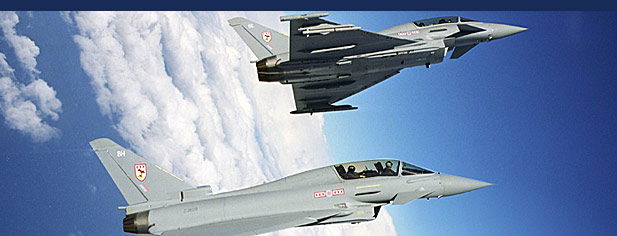
Photo : Two Typhoon T1s of 29 (Reserve) Squadron
[Picture: RAF]
(27.03.2007)
|



 4/5 Generation Fighters