Technology is no guarantee of victory

Exotic firepower is less important than adequate force levels
The proposed 2008 Pentagon budget requests $75 billion for research and development of new weapons. The desire for new high-tech systems is so great that despite the heavy strains even the small wars in Iraq and Afghanistan have placed on U.S. military personnel, the services have been asked to trade manpower for hardware.
Within tight defense budgets, the notion is fostered that exotic firepower is more important than boots on the ground, even though the actual experience of our current wars indicates that the lack of ground troops has created the all-important political perception that American strategy has failed in Iraq.
This technophilia was closely identified with Defense Secretary Donald Rumsfeld. His minimalist campaign plan for Iraq and rejection of calls to rebuild U.S. ground forces after the massive cuts of the 1990s were meant to transform the military into a small, agile, high-tech force that could avoid the messy slogging of traditional combat.
In World War II, the number of planned Army divisions was cut so that more heavy bombers could be built to pound Axis cities. The result was a shortage of infantry as American forces fought their way into Germany.
This is not to deny the advantage superior technology gives U.S. troops. The insurgents have not advanced beyond terrorist tactics because they cannot field an army that can contest for territory or state power against the world’s best professional soldiers.
Yet, today, terrorists proclaim they are winning, while American politicians are calling for withdrawal. The war effort has not become unpopular in the polls because of a lack of advanced technology, nor will the political viability of future wars be increased merely by deploying new generations of hardware.
Enemies in Iraq and Afghanistan are using low-cost assault rifles, rocket-propelled grenades, improvised explosives, mortars and suicide bombers to defeat politically the high-tech legions of the U.S. and NATO, which seem hard-pressed to sustain themselves.
With 300 million people and a $14 trillion economy, U.S. potential is unrivaled by any combination of Middle East enemies. The weakness is in America’s will to sustain the kind of campaign needed to grind down fanatical opponents. The high civilization of postmodern America seems unable to stand up to the ruthless exponents of Dark Age doctrines.
Can a research-and-procurement strategy that shows accelerating costs in pursuit of immature technologies be sustained in the face of apparent failure in the field against lightly armed opponents? Might it not be wiser to address the real shortfalls in American combat capabilities, the inadequate force levels on the ground (and increasingly in the air and at sea), by building a larger number of proven systems from an industrial base that can better react to surge requirements?
The home front is the decisive theater of war. When U.S. tanks were rolling toward Baghdad in 2003, support for the war was nearly universal. It has waned as the glow of victory has faded.
Thucydides, in his history of the Peloponnesian War, concluded from his direct observation that rich and democratic Athens lost to authoritarian Sparta because Athenians fell into internal political conflict.
The crippling defeat in Sicily was less a strategic error than the fault of “the senders not deciding to make proper provision for those who had gone out [to fight], but choosing instead to occupy themselves in private quarrels regarding the leadership of the people.”
If this sounds familiar, it is because there are matters of strategy and politics that technological progress cannot solve.
The writer is senior fellow for National Security Studies at the U.S. Business and Industry Council in Washington.
Source : By William Hawkins— AirForceTmes --
(www.airforcetimes.com)
Posted : May 20, 2007
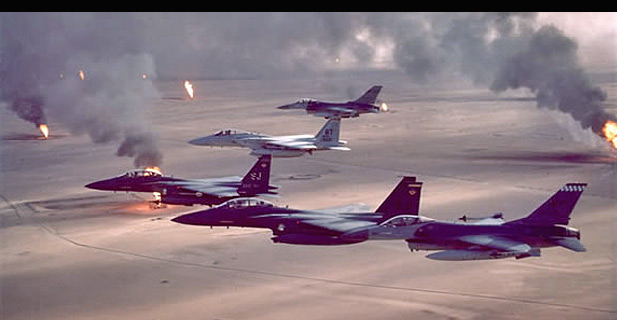
Photo : F-16C and F-15C’s over Iraq. [ www.aviationexplorer.com photo]
(20.05.2007)
|



 4/5 Generation Fighters