MB-339 Training Jet: An All-Italian Success Story

From pilot training to aerobatic excellence, the Aermacchi MB-339 embodies Italy’s aviation heritage and innovation.
From basic instruction to aerobatic display, the Aermacchi MB-339 forged Italy’s reputation in military pilot training and light combat aviation, and its legacy continues as the Italian Air Force transitions to next‑generation trainers.
The Aermacchi MB-339 is more than just a training aircraft—it represents three distinct identities: a reliable jet for air force pilot instruction, a capable light strike aircraft proven in operational use, and a symbol of national pride, showcased by two of the world’s most renowned aerobatic teams: Italy’s Frecce Tricolori and the United Arab Emirates’ Al Fursan.
Developed as the successor to the revolutionary MB.326, the MB-339 consolidated Leonardo’s position as a global leader in military training aircraft. First flown in the late 1970s, the jet combined simplicity, robustness, and agility, making it suitable for every stage of pilot training—from basic instruction to advanced maneuvers.
Industrial efficiency was another hallmark of the MB-339. Built using conventional processes, it was easy to produce under license in countries where the MB.326 had already achieved success. Its versatility extended beyond training: the aircraft proved effective as a light combat platform, offering reliability, low maintenance, and impressive load capacity.
The MB-339’s aerobatic legacy is inseparable from the Frecce Tricolori. Initially met with skepticism due to its straight wing design, the aircraft ultimately became the team’s defining feature, demanding precision and rewarding perfectionism. Over time, its forgiving flight characteristics and agility cemented its reputation among pilots worldwide.
Operationally, the MB-339 served with multiple air forces, including Italy, Argentina, Peru, Malaysia, New Zealand, Nigeria, the UAE, Eritrea, and Ghana. It even competed in the U.S. Joint Primary Aircraft Training System (JPATS) program in 1990, though the contract ultimately went to the T-6 Texan II. Despite this, the MB-339 remained a respected platform, later modernized into the MB-339CD variant with advanced avionics.
Today, the Italian Air Force is gradually replacing the MB-339 with the modern M-345, part of a new generation of trainers that includes the M-346 and integrated simulation systems. Yet the MB-339’s legacy endures. As Instructor Pilot Stefano Centioni—veteran of the Frecce Tricolori—recalls, the “Macchino” was not only a forgiving and efficient trainer but also a source of pride, allowing pilots to master “the art of piloting” while representing Italy on the global stage.
From its industrial roots to its aerobatic triumphs, the MB-339 remains a milestone in aviation history—an aircraft that trained generations, supported combat missions, and carried Italy’s tricolor across the skies.
The Aermacchi MB-339 was developed in the 1970s as the successor to the MB.326 and quickly established itself as a versatile, robust, and easy‑to‑maintain jet trainer used across multiple air forces worldwide. Its straightforward design and reliable performance made it suitable for every phase of pilot instruction, from elementary jet handling to advanced tactical manoeuvres.
Industrial efficiency and exportability were central to the MB-339’s success. Built using conventional production techniques, the type was licensed and produced in countries that had previously adopted the MB.326, consolidating Leonardo’s position as a global leader in military training aircraft. The platform’s adaptability also allowed it to serve as a light strike aircraft, valued for low maintenance needs and respectable payload capacity in operational deployments.
The MB-339’s cultural and aerobatic impact is inseparable from Italy’s Frecce Tricolori display team. Despite early skepticism about its straight‑wing layout, the jet’s forgiving handling and precision responsiveness made it the team’s hallmark for decades, helping to cement the MB-339’s reputation among display pilots and audiences alike. The type also served with aerobatic teams abroad, including the UAE’s Al Fursan, underscoring its international appeal.
Operational service extended across continents: Italy, Argentina, Peru, Malaysia, New Zealand, Nigeria, the UAE, Eritrea, and Ghana all flew MB-339s, and the type later evolved into modernized variants such as the MB-339CD with upgraded avionics to meet contemporary training needs. Although it competed in the U.S. JPATS program in 1990, the MB-339 ultimately lost to the T‑6 Texan II, yet it remained a respected and widely used trainer.
Transition and legacy: Italy has begun replacing the MB-339 with newer platforms—most notably the M-345 and the M-346—forming a modern, integrated training pipeline that pairs advanced jet trainers with simulation systems. Recent service updates confirm the M-345’s induction into the Italian Air Force training wings, marking a formal handover from the MB-339 era. Meanwhile, the Frecce Tricolori are moving toward the M-346 for display duties, signaling the MB-339’s retirement from frontline aerobatic service but not from aviation history.
The MB-339’s combination of simplicity, agility, and industrial practicality made it a milestone in training and light combat aviation. Its influence persists in Leonardo’s trainer lineage and in the pilots it helped shape—an enduring chapter in Italy’s aerospace story.
Source: Leonadordo & ©XAirForces News, 09 January 2026
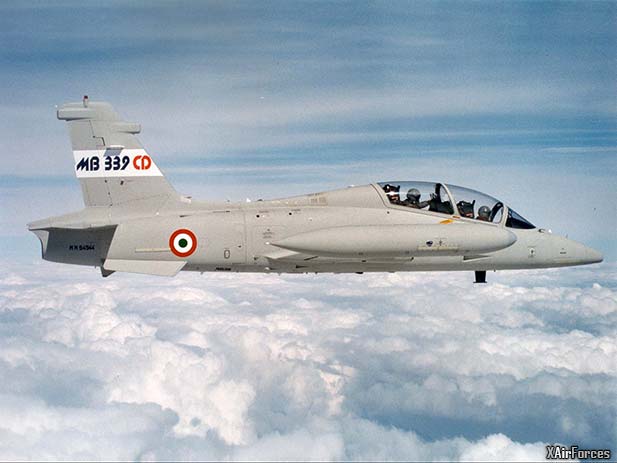
Photo: The prototype of the MB-339CD equipped with multifunction displays and more modern avionics. (Photo by ©Leonadordo)
Editor: Luccia Gatti (©XAirForces Defense Aviation and SCI New Technologies Editor from Italy)
Keywords: advanced trainerAermacchiaerobatic teamAl Fursanaviation historyFrecce Tricoloriglobal export aircraftItalian Air ForceItalian aviation industryItaly MB-339jet trainer legacyLeonardo aircraftlight combat aircraftM-345M-346MB-326 successorMB-339CDMilitary Aviationmilitary trainer jetpilot training
MB-339 Training Jet: An All-Italian Success Story
(9.01.2026)
|



 4/5 Generation Fighters