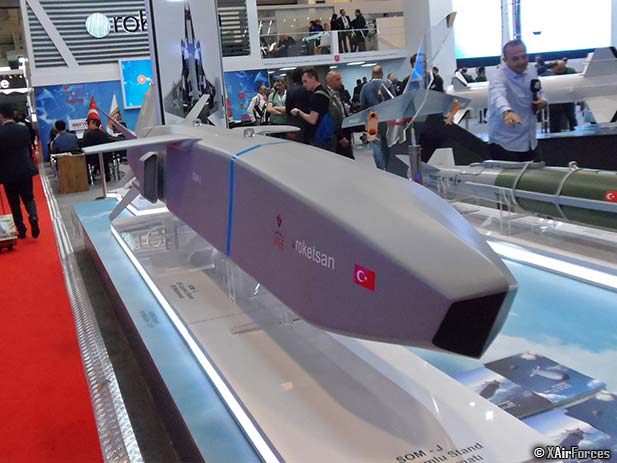
Azerbaijan Becomes First Nation to Field Turkey’s SOM-Ş Cross-Platform Cruise Missile

Integration of Turkish-made SOM-Ş missiles marks a doctrinal shift in Azerbaijan’s airpower, bridging NATO and Soviet-era platforms while reshaping the South Caucasus security balance.
Azerbaijan has become the world’s first country to operationally deploy Turkey’s SOM-Ş (SOM Şahin) air-launched cruise missile, a milestone that redefines the region’s airpower dynamics and highlights Ankara’s growing defense export capabilities. The continued delivery of SOM-Ş missiles under a 2021 contract signals a profound doctrinal shift in Azerbaijan’s approach to air warfare.
Unlike traditional platform-centric doctrines, Azerbaijan is now emphasizing munitions-based dominance, where precision, standoff range, survivability, and cross-platform compatibility outweigh fleet size or pilot numbers. The SOM-Ş is unique in its ability to integrate seamlessly with both Western-oriented unmanned combat aerial vehicles (UCAVs) and Soviet-era strike aircraft, effectively bridging decades of technological and doctrinal divides.
From an operational perspective, the SOM-Ş enables Azerbaijan to impose multi-axis, layered attack dilemmas on adversaries, separating destructive power from limited high-value platforms. This increases sortie survivability while complicating enemy defensive decision-making. The missile’s integration also reflects the maturity of Azerbaijan’s command-and-control and ISR infrastructure, as effective standoff strike capability requires advanced target confirmation and mission planning.
Strategically, the SOM-Ş blurs the line between tactical and strategic strike capabilities, allowing Azerbaijan to threaten high-value military and dual-use targets without crossing escalation thresholds typically associated with ballistic missiles. This positions Azerbaijan for network-based, sustained competition rather than episodic conflict, consolidating battlefield advantages gained during the 2020 Nagorno-Karabakh war.
Historical Context of the Türkiye–Azerbaijan Missile Partnership
Azerbaijan’s pursuit of the SOM family of cruise missiles stems from its post-Soviet need to modernize armed forces amid chronic instability and shifting alliances. Turkey emerged as the natural partner, combining NATO membership, cultural ties, and a maturing defense industry willing to adapt systems to Baku’s requirements.
Momentum accelerated in the mid-2010s as Turkish precision-guided munitions proved effective in multiple theaters. A symbolic milestone came on June 26, 2018, when Azerbaijan displayed a SOM-B1 replica during a military parade in Baku, signaling deterrence intent and commitment to long-range strike capability.
The official export contract, signed on February 19, 2021, was valued at US$300–400 million and finalized after Azerbaijan’s battlefield successes in 2020. This agreement reflects years of joint testing, doctrinal alignment, and integration planning, ensuring the missiles are not only delivered but fully absorbed into Azerbaijan’s operational ecosystem.
SOM-Ş: Azerbaijan’s Strategic Cruise Missile for Flexible, Cross-Platform Airpower
Turkey’s SOM-Ş missile family delivers precision strike capability across NATO UAVs and Soviet-era aircraft, reshaping the South Caucasus security balance
The SOM-Ş (SOM Şahin) cruise missile represents a new generation of autonomous, low-profile air-launched weapons designed to penetrate modern integrated air defense systems and strike high-value targets deep inside adversary territory. For Azerbaijan, the system provides a decisive leap in long-range precision strike capability, fully aligned with its operational needs in the South Caucasus.
With a range exceeding 250 kilometers, a low radar cross-section, and subsonic flight optimized for terrain-hugging camouflage, the SOM-Ş allows launch platforms to remain outside hostile airspace while delivering powerful kinetic effects. Its advanced guidance system—combining inertial navigation, satellite navigation, terrain reference, and imaging infrared terminal guidance—ensures accuracy even in GPS-denied environments, a critical advantage in modern electronic warfare.
The missile’s 230-kilogram warhead options, including high-explosive fragmentation and tandem penetrators, provide flexibility from infrastructure denial to hardened target destruction. A key milestone in the program was the transition from the French Microturbo TRI-40 engine to Turkey’s indigenous KTJ-3200 turbojet, eliminating export restrictions and ensuring production autonomy.
Operational Flexibility and UBAS Integration
Through the Unmanned Aircraft Firing System (UBAS), SOM-Ş separates launch authorization, targeting data, and mission execution from platform-specific avionics. This enables deployment from both NATO-standard UCAVs such as the Bayraktar Akıncı and Soviet-era aircraft like the Su-25 Frogfoot, without major modifications.
Successful launch tests from a modified Azerbaijani Su-25 in 2025 confirmed the missile’s ability to bridge Cold War-era hardware with modern network-centric warfare. This cross-platform compatibility reduces training and logistics complexity while extending the relevance of legacy aircraft.
By distributing long-range firepower across multiple launch nodes, Azerbaijan complicates adversary detection and countermeasure planning. This layered strike concept combines high-endurance unmanned assets with low-profile manned aircraft, increasing survivability and imposing multi-axis dilemmas on opponents.
Regional and Industrial Implications
The SOM-Ş program demonstrates how medium-sized powers can overcome modernization constraints by adopting munitions-based solutions rather than costly fleet replacements. For Azerbaijan, this restores long-range strike credibility while retaining legacy assets under fiscal and political pressure.
Regionally, SOM-Ş accelerates a qualitative shift in the South Caucasus military balance, where accuracy and standoff range outweigh numerical superiority. For Armenia and neighboring actors, the missile underscores the difficulty of countering survivable, adaptive cruise systems.
Industrially, SOM-Ş strengthens Turkey’s position as a global exporter of advanced strike systems, contributing to defense exports exceeding US$6 billion annually. The program highlights a new arms export model based on adaptability, cross-integration, and technological sovereignty, positioning Turkey as an alternative hub to Western and Russian suppliers.
Strategic Signals and Future of Airpower
Azerbaijan’s acquisition of SOM-Ş is more than a firepower upgrade—it is a strategic statement of autonomy, adaptability, and deterrence. By focusing on munitions rather than platforms, Azerbaijan shifts toward an effects-based doctrine, where precision strikes define airpower superiority.
In the South Caucasus, SOM-Ş marks a structural change in conflict dynamics, emphasizing precision escalation thresholds over mass mobilization. Its survivability in contested electronic warfare environments reinforces deterrence by uncertainty, forcing adversaries to defend a broader spectrum of targets with limited resources.
Ultimately, SOM-Ş symbolizes a new paradigm of modern air warfare—defined by modularity, industrial sovereignty, and strategic durability. For Azerbaijan, it ensures sustainable operational advantage, integrating ISR, unmanned systems, and precision strikes into a digital kill chain that reshapes both regional security and global defense industry trends.
SOM-Ş: Strategic Signals and the Future of Azerbaijan’s Air Power
Azerbaijan’s deployment of Turkey’s SOM-Ş cruise missile marks a doctrinal shift toward autonomy, adaptability, and deterrence in the South Caucasus.
Azerbaijan’s acquisition of the Turkish-made SOM-Ş cruise missile represents far more than an increase in firepower. It is a strategic declaration of autonomy, adaptability, and deterrence in an increasingly volatile geopolitical environment. By combining Türkiye’s indigenous innovations with Azerbaijan’s operational requirements, Baku has secured long-range strike capabilities that reshape the regional airpower equation while reducing exposure to external political pressures.
The SOM-Ş’s cross-platform compatibility—operable from both NATO-standard unmanned combat aerial vehicles and Soviet-era attack aircraft—marks a doctrinal shift from platform-based airpower to effects-based design, where lethal force is concentrated in the munition rather than the aircraft. This flexibility allows Azerbaijan to maximize lethality without requiring wholesale fleet replacement.
In the South Caucasus, the arrival of SOM-Ş signals a structural transformation in conflict dynamics, shifting emphasis from mass mobilization to precision escalation thresholds. The missile embodies a new paradigm of modern air warfare defined by modularity, industrial sovereignty, and strategic durability, rather than prestige platforms alone.
Survivability and Deterrence
SOM-Ş’s ability to operate in electronic warfare and contested airspace environments reinforces an uncertainty-based deterrence model. Adversaries are compelled to defend a wider spectrum of potential targets with limited resources, complicating their defensive planning and increasing fiscal strain.
By enabling precise, layered, and sustained strikes from outside enemy air defense perimeters, Azerbaijan demonstrates strategic awareness that future advantage in high-intensity conflicts depends less on absolute air dominance and more on survivable, distributed strike capability.
Warfare and Geopolitical Impact
Within the framework of long-term airpower development, SOM-Ş accelerates Azerbaijan’s transition toward an integrated warfare model that fuses ISR, unmanned systems, and precision strikes into a digital kill chain. This integration enhances resilience, self-reliance, and unpredictability—qualities that increasingly shape stability and security in the South Caucasus.
From a geopolitical perspective, the acquisition strengthens Azerbaijan’s negotiating position by adding a credible military dimension to its diplomacy. The presence of SOM-Ş raises the strategic cost of coercion or escalation attempts by adversaries, reinforcing deterrence while consolidating Azerbaijan’s role as a regional power.
Conclusion
The integration of SOM-Ş into Azerbaijan’s operational doctrine marks the emergence of a regional air force that is more resilient, self-sufficient, and strategically unpredictable. This evolution underscores a broader shift in modern air warfare, where precision, survivability, and adaptability outweigh sheer numbers, and where munitions—not platforms—define the future of deterrence and conflict.
Source: Baku ©XAirForces News, 12 January 2026
Photo: Azerbaijan has become the first nation to deploy Turkey’s SOM-Ş cruise missile, integrating NATO UAVs and Soviet-era aircraft. With a 250 km range, advanced guidance, and cross-platform compatibility, SOM-Ş reshapes South Caucasus airpower and highlights Turkey’s growing defense export capabilities. (05 05 2019. Turkish MKE Roketsan SOM-J (IDEF'19) Photo by Mahir Özkan ©XAirForces)
Editor: Huseyin Qadirov (Turkish World ©XAirForces News Editor from Baku/Azerbaijan)
Keywords: Azerbaijan, SOM-Ş, Azerbaijan Air Force, Turkey defense exports, cruise missile, South Caucasus, NATO UCAV, Su-25 Frogfoot, precision strike, deterrence, KTJ-3200 engine, Azerbaijan first to deploy SOM-Ş cruise missile, Turkey SOM-Ş missile export to Azerbaijan, cross-platform missile integration NATO UCAVs and Soviet aircraft, Azerbaijan long-range precision strike capability, South Caucasus military balance shift, Azerbaijan deterrence strategy with SOM-Ş, UBAS firing system integration, Azerbaijan Su-25 SOM-Ş launch test 2025, Turkey KTJ-3200 indigenous engine cruise missile, Azerbaijan ISR and command integration for standoff strikes, effects-based doctrine in Azerbaijan airpower, modular precision strike weapons reshaping regional conflict dynamics
Azerbaijan Air Force Roketsan SOM-Ş cruise missile deployment
(12.01.2026)
|



 4/5 Generation Fighters